
Little by Little, Then All at Once: How Nations Lose Territory Without a Shot Fired
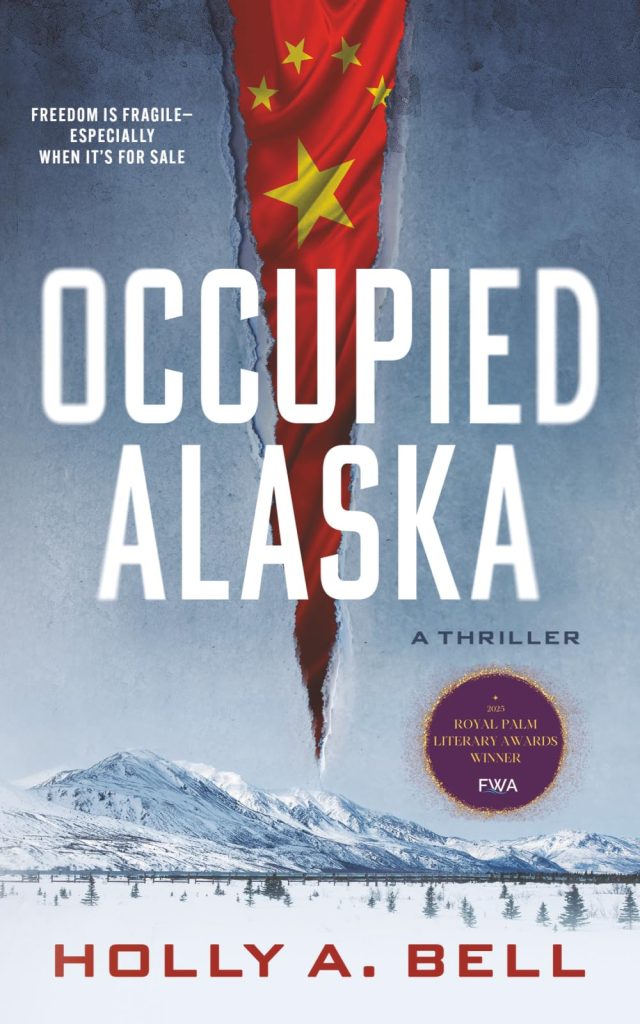
The loss of sovereign territory has traditionally been understood as a military event, for example, through an invasion, an occupation or a flag raised over conquered ground. But a different and arguably more dangerous form of territorial loss has been unfolding for years, hidden inside routine economic decisions that, taken individually, look entirely reasonable. This is the argument at the heart of Occupied Alaska, a geopolitical novel by economist Dr. Holly Bell, and it is not nearly as speculative as its genre suggests.
Bell’s fiction draws directly on a real episode from 2017, when Alaska and a Chinese state-linked company signed an agreement for a proposed $43 billion liquefied natural gas pipeline. On paper, it was an infrastructure deal, the kind governments pursue every day to create jobs, attract investment and unlock stranded resources. But according to Bell, who worked against the project at the time, every credible economic analysis concluded the pipeline would never turn a profit. That was precisely the point worth investigating: if the project made no commercial sense, why did a foreign state-linked company want to build it anyway?
The answer, Bell argues, lies in what happens when a resource-rich but economically vulnerable region takes on debt it cannot realistically repay. The proposed terms would have given China roughly 75 percent of the gas at cost, along with the revenue needed to pay itself back, leaving Alaska with a fraction of the value and a loan it had little hope of servicing. This is not a hypothetical concern. Sri Lanka and Djibouti offer sobering precedents: both accepted major Chinese-backed infrastructure loans to solve immediate economic problems, and over time watched critical assets; ports, railways, logistics hub, become entangled in foreign commercial interests. In Djibouti’s case, that commercial entanglement was eventually followed by a sustained Chinese military presence, ostensibly to protect the investment.
The question Bell’s work raises is whether a US state could follow the same trajectory. It is easy to dismiss the idea as far-fetched when applied to American soil, but the mechanics are the same everywhere: financial dependence, once established, tends to expand. The 2017 pipeline proposal did not exist in isolation. During the same period, Chinese interests were pursuing a purchase of the Chicago Stock Exchange, a deal that would have allowed Chinese companies to list on an American exchange under rules a foreign buyer helped shape. Simultaneously, there was a wave of Chinese acquisitions of US agricultural land, including an attempted corn-milling and export operation. Individually, each of these moves could be framed as ordinary commercial activity. Collectively, they represented a coordinated push into three foundational sectors: energy, food, and finance.
This is the accumulation problem that regulators, in Bell’s view, consistently underestimate. Reviewing a pipeline deal, a land purchase, or a stock exchange transaction in isolation misses the pattern that only becomes visible when the deals are considered together. Bell credits agencies like the Committee on Foreign Investment in the United States (CFIUS) with improving scrutiny since 2017, the Chicago Stock Exchange bid, notably, was ultimately blocked at the Securities and Exchange Commission stage, but she argues that stronger, more holistic review processes are still needed, along with far greater transparency about who actually finances major infrastructure projects. Alaska’s gas pipeline, now being developed by a different company without direct Chinese involvement, is still moving forward using decade-old cost estimates and undisclosed financing sources, a pattern Bell sees as part of the same underlying problem.
Alaska’s strategic profile makes the stakes unusually high. The state holds vast oil and gas reserves along with an estimated 57 of the 60 rare earth elements the US currently imports from China, sits just 2.4 miles from Russian territory at its closest point, and lies directly along the emerging Arctic shipping lanes China has branded the “Polar Silk Road.” Much of the region’s existing defense posture, Bell notes, remains oriented around Cold War-era threats rather than the newer economic and infrastructure vulnerabilities now in play.
Perhaps the most difficult question Bell’s work raises is structural rather than technical: do democracies face an inherent disadvantage in this contest? Elected leaders operate on two-to-four-year cycles, while authoritarian competitors can plan across decades and quietly cultivate influence through financing, land use decisions, and personal relationships with policymakers. Bell traces this dynamic through her own observations of shifting US posture toward China, and argues that economic dependence, once it takes hold, tends to convert into political leverage almost automatically, through campaign financing, regulatory influence, and control over increasingly vital assets like data infrastructure.
Territory, in this reading, is not only lost to armies. It can be lost to balance sheets, one commercially rational decision at a time, until the accumulation of dependence forecloses the choices a nation believed it still had.