Global Disorder and the Limits of the Rules-Based International Order
The defining feature of today’s international system is not the emergence of a new balance of power, but the absence of a shared framework through which power is exercised. Rather than transition, the system is characterised by fragmentation, uncertainty, and weak consensus over rules, norms, and responsibilities.
In a recent episode of The International Risk Podcast, Dr Bobo Lo described this moment succinctly: “What we have today is not so much a new world order, but rather a world disorder.” This diagnosis forms the core of his most recent published work, The Disorderly Society: Rethinking Global Governance in an Age of Anarchy, which argues that the post-Cold War rules-based international order has unravelled, while no credible alternative has emerged in its place.

The collapse of a Western-designed order
The rules-based international order associated with US leadership after the Cold War depended on a historically unusual alignment of power, vision, and political will. As Dr Lo notes in the podcast, “the 1990s were a unique moment… that combination of power, vision, and will simply doesn’t exist anymore.”
Attempts to revive that order often underestimate the extent to which its legitimacy has eroded. Dr Lo argues that one of its core weaknesses was always perception: “It is widely seen by the rest of the world as something built by the West for the West.” That perception has been reinforced by selective adherence to international law, military interventions without broad consent, and inconsistent responses to crises.
This critique is echoed in Dr Lo’s analysis on the war in Ukraine, which argues that the conflict has accelerated the erosion of global order but has not produced a coherent replacement. Rather than triggering a rebirth of rules-based governance, the war has highlighted how divided global responses remain, particularly between Western states and much of the Global South.
Why “multipolarity” fails as an explanation
One of Dr Lo’s central arguments is that commonly used labels such as multipolarity obscure more than they explain.
The problem, Dr Lo explains, is not only that the United States remains the single most powerful actor, but that there is no agreement over who the other “poles” are supposed to be. China sees a bipolar world. Russia imagines a tripolar balance. India and Brazil view themselves as emerging global powers. “Multipolarity,” Dr Lo concludes, “is in the eye of the beholder.”
Crucially, order implies coordination. As he states in the episode, “order means that major players come together to manage the world. We are seeing no evidence of that happening at all.” This absence of collective management is what distinguishes disorder from transition.
China, Russia, and the limits of alignment
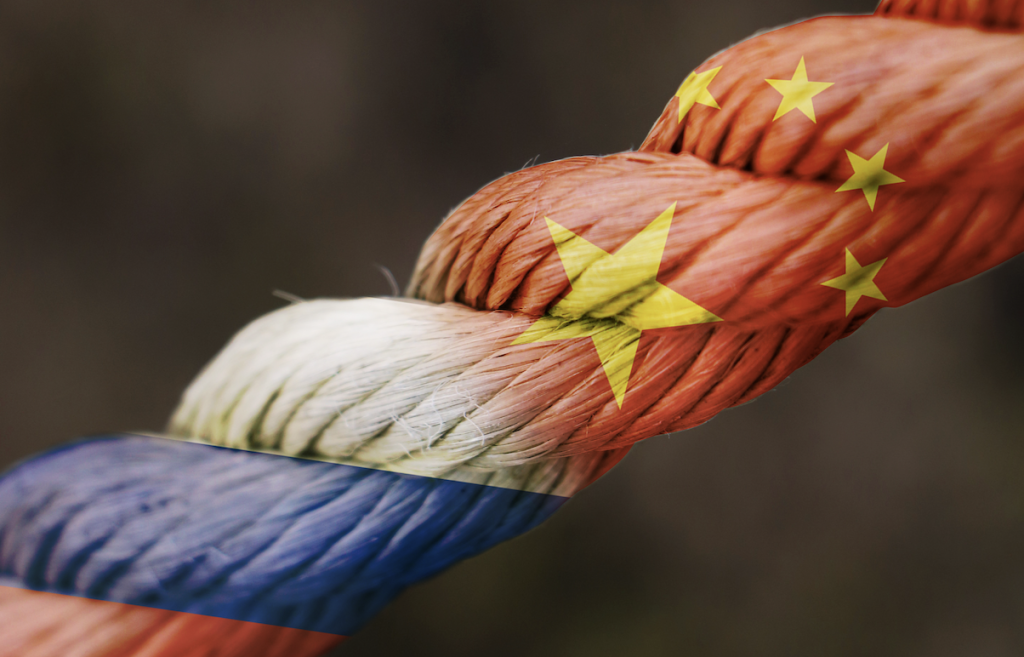
Dr Lo’s long-standing work on Sino-Russian relations provides a concrete illustration of disorder without alignment. In his CEPA report, War and Sino-Russian Partnership: An Indispensable but Uneasy Relationship, he characterises the relationship as “indispensable but uneasy” – a partnership driven by necessity rather than shared vision.
This view is reiterated in the podcast episode, where Dr Lo describes the relationship as “a partnership of strategic convenience.” While both states oppose aspects of US dominance, their strategic objectives diverge sharply. China, Lo argues, seeks to revise the international system from within, whereas Russia benefits from its breakdown.
The war in Ukraine has intensified this divergence. Drawing on his Lowy analysis, Dr Lo explains that Beijing does not want Moscow to lose, but neither does it want a decisive Russian victory. “China doesn’t want Russia to lose, but it also doesn’t want Russia to win too well,” he notes. A triumphant and emboldened Russia would become more disruptive globally and potentially less responsive to Chinese interests.
Western credibility and the exploitation of weakness
A recurring theme in both the podcast and Lo’s recent commentary is that China and Russia have not created disorder so much as exploited it. In the episode, Lo states plainly:
“They have not created the problems of the rules-based international order…they have exploited its weaknesses.”
This point is reinforced a recent POLITICO article, where Dr Lo is quoted arguing that Western inconsistency – particularly around sovereignty and intervention – has made it easier for authoritarian leaders to deflect criticism. In the podcast episode, he draws a direct comparison between reactions to the invasion of Ukraine and earlier Western actions:
“Much of the global South thinks: it’s bad, but it’s no worse than what George W. Bush did in 2003.”
Whether Western governments accept that equivalence is beside the point. As Lo observes, “much of the world doesn’t care.” The result is diminished moral authority and weaker international alignment.

A ‘perfect storm’ of systemic risks
Disorder is particularly dangerous because it coincides with what Dr Lo calls a “perfect storm of threats.” In the podcast, he lists runaway climate change, the likelihood of more frequent pandemics, stagnant global poverty, technological disruption, mass disinformation, and heightened geopolitical confrontation.
These risks are interconnected. Climate change drives displacement and instability. Poverty fuels migration and political backlash. Technological change reshapes labour markets and information environments. Without a functioning framework for cooperation, Lo warns, “we have zero chance of addressing all these threats and challenges successfully.”
The case for a new internationalism
Rather than advocating a return to past models, The Disorderly Society proposes a new internationalism built on three principles: reconceptualised self-interest, representativeness and inclusiveness, and flexibility.
Self-interest, Dr Lo argues, cannot be transcended – but it must be understood differently. “Global poverty is not just a human tragedy,” he says in the podcast. “It has a direct destabilising impact on Western societies.” Climate change and pandemics illustrate the same logic: isolation is illusory.
Representation is equally critical. Drawing on his Lowy Institute work, Dr Lo argues that an order that marginalises the Global South is structurally unsustainable. Support on issues such as Ukraine or Gaza cannot be assumed if decision-making excludes the majority of the world’s states.
Finally, flexibility is essential. Dr Lo rejects the illusion of universal values enforced uniformly. A viable order, he argues, must accommodate diversity and focus on behaviour in the international arena rather than domestic political systems.
Agency in an age of disorder
Despite the bleak diagnosis, Dr Lo resists fatalism. He reminds us that many transformative moments in history once appeared improbable. “Nothing is inevitable,” he says. “We have agency.”
As existential risks become more immediate, the incentives for cooperation may grow. Lo draws an analogy with the post-1945 period, when states with profound differences came together out of necessity. The choice today is stark: adapt global governance to shared realities, or allow disorder to deepen.
As The Disorderly Society concludes, the rules-based order of the past is over. But a new, flatter, more inclusive order remains possible – and necessary. Fatalism, Dr Lo insists, is not realism. It is abdication.