Putin in New Delhi: India’s High-Stakes Multlialignment Balancing Act
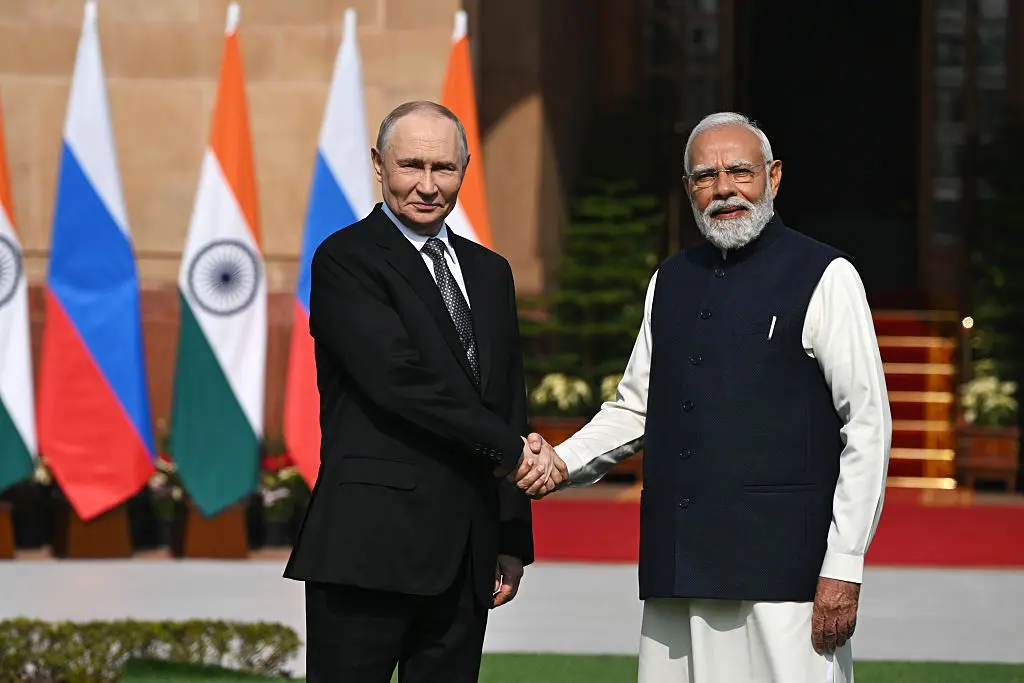
When Vladimir Putin touched down in New Delhi last week, the first time since Russia’s invasion of Ukraine, the symbolism mattered far more than Moscow’s assurance of ‘uninterrupted‘ oil supplies. It served as a timely reminder that, even amid a shake-up of the global balance of power and geopolitical fragmentation, the India-Russia relationship remains resilient, what India’s External Affairs minister has repeatedly called “the only constant in world politics.” The roots of the relationship date back to Soviet-era support, particularly during the 1971 India-Pakistan war, and Russia’s use of its UN Security Council veto for India’s benefit on Kashmir-related resolutions.
This constancy reflects something deeper than nostalgia for Cold War camaraderie. It is a cornerstone of India’s foreign policy identity: a determination to protect strategic autonomy—the ability to make decisions free from external pressure—even as geopolitical camps harden. New Delhi’s ties with Moscow exist in parallel with deepening technology and innovation cooperation with the United States and its vast, if fraught, trade relationship with China. India has several free trade agreements in place, including with the EU, Japan and UK, is a key member of the QUAD dialogues, while also playing an active role in the Shanghai Cooperation Organisation SCO and BRICS.
Prime Minister Modi describes this approach as maintaining “equal closeness to all nations”, in contrast to former Prime Minister Jawaharlal Nehru’s policy of nonalignment, which emphasised maintaining distance from all blocs during the Cold War. Rather than choosing sides, India is hedging its bets, maximising its options, reducing overdependence on any single alliance and avoiding entanglement in others’ conflicts. Nowhere is this more clearly demonstrated than in India’s management of relations with Russia and Ukraine throughout the ongoing war. India has become the second-largest importer of Russian crude oil, capitalising on discounted barrels, while simultaneously remaining the largest exporter of diesel to Ukraine, highlighting the transactional pragmatism underpinning its multi-alignment doctrine.
Still, the critical question is whether India can keep defying pressures to choose sides. Multi-alignment has provided flexibility; helped deliver growth, security, investment and diplomatic headroom. However, it will come under increasing strain if India’s major partners begin to see India’s simultaneous engagements with their rivals as unacceptable. A key risk is that Washington stops viewing India as an indispensable counterbalance to China in the Indo-Pacific. This summer, the United States imposed two rounds of 25% tariffs on Indian goods, alongside reforms to the H-1B visas, disproportionately hitting India—a country whose professionals previously held around 75% of those visas. Can India afford to lose its partnership with the US entirely?
Meanwhile, Russia’s growing alignment and dependence on Beijing introduces another uncomfortable risk. China is becoming increasingly assertive along the Himalayan border, including announcing that it has started to build the world’s largest megadam, three times the size of the Three Gorges Dam, 30km from the Indian border with Tibet. Additionally, warming Russia-Pakistan ties, illustrated by Prime Minister Shehbaz Sharif’s recent visit to Moscow and expanding energy contracts and joint military exercises, raise further concerns in New Delhi, at a time when India-Pakistan relations are at their lowest point in years with the worst clashes in decades and India’s suspension of the Indus Water Treaty.
For now, Putin’s reception in New Delhi signals continuity and confidence. India is sending a clear message: it is doubling down on strategic autonomy. It will cooperate with the United States, manage competition with China, and sustain its crucial ties with Russia. Whether that balancing act proves to be a strategic asset or a high-stakes gamble will shape India’s future and potential as a rising global power.
To find out more about how India is navigating a rapidly shifting global order with intensifying geopolitical rivals by deepening ties with competing powers while doubling down on strategic autonomy, listen to episode 295: India’s Strategic Autonomy and Multialignment Approach in 2025 with Dominic Bowen.