
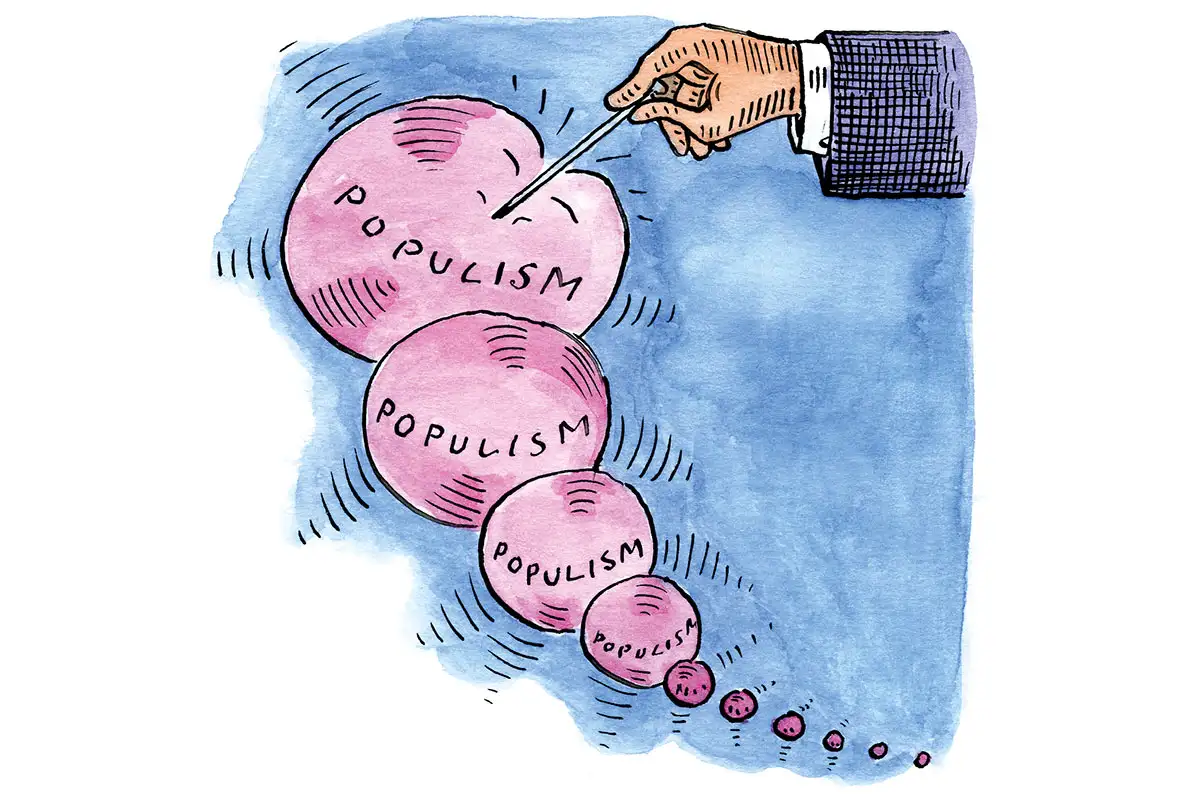
UK and world politics: how do we adapt to dying party systems? With special guest Lord Jonathan Sumption
Our guest today is none other than a former UK High Court Justice with decades of experience as a historian and a lawman.
With the intention to learn more about history and the shifting tendencies in the UK politics, from a two-party system to a more challenging, plural and perhaps populist one, we learn about international dynamics, law and politics’ imbrications, a theory of a breakup with the sense of self-actualisation and how people react to change in ways that don’t necessarily benefit them economically.
Framing the historical lens: Whigs vs Tories – how modern party politics formed under mass democracy
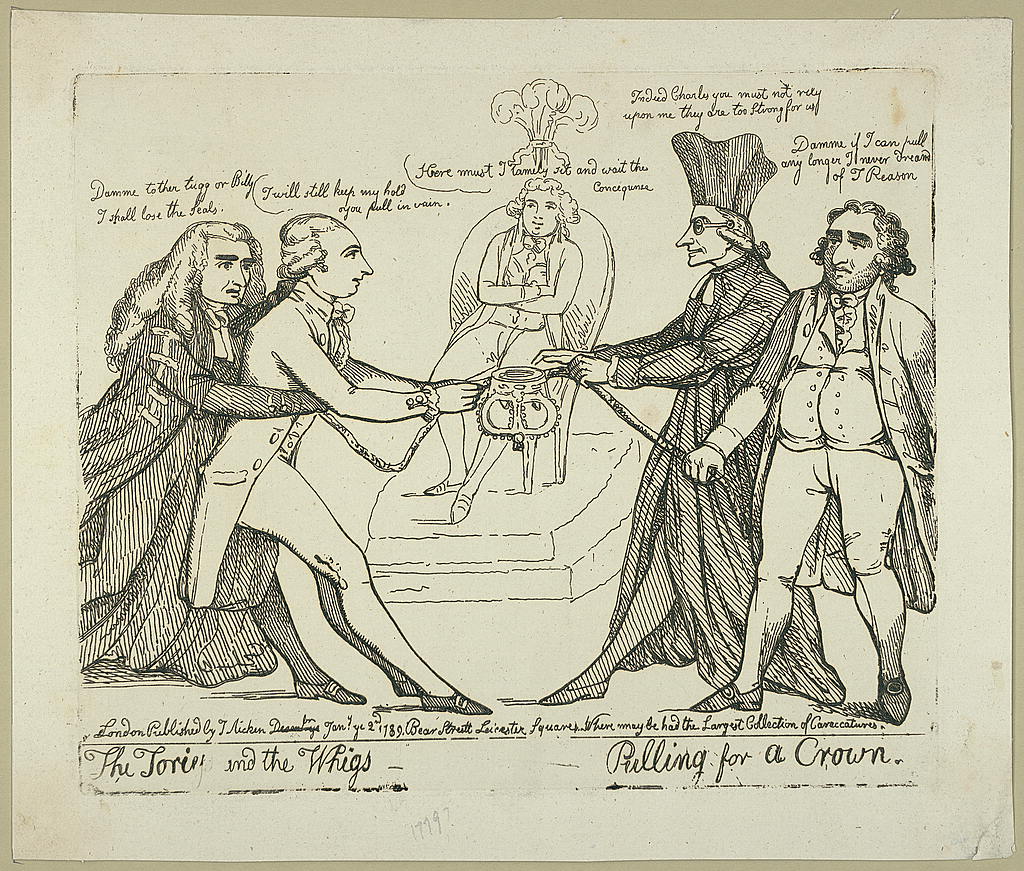
Satirical print of Whigs and Tories in historical British politics. Source: The Tories and the Whigs Pulling for a Crown, Encyclopedia Virginia. Credit: Library of Congress Prints & Photographs Division
In 1679, a section of the opposition to the King’s court took on a religious dimension, strongly opposing the Church’s persecution of Protestants and the Duke of York’s possible succession to the throne. This group became known as the Whigs, non-Anglican Protestants, succeeding in the elections to exclude several Parliaments, using propaganda through strategic organisation. In reaction to that, another ideology formed in 1681, known as the ‘Tory’ ideology, Anglicans, supporting the monarchy and the Church.
The Whigs and Tories’ relation to government changed over time, but their fight for power remained the same. They are seen as the embryonic political parties in England.
In 1867, an electoral reform enlarged the British electorate to include the middle classes and the “labour aristocracy” (the best-paid skilled workers). From then onward, the parties structured themselves further to center their goals and public speech on winning elections.
This new bipartisan model greatly influenced political systems abroad: the US, France, and Northern European countries followed.
According to Rémy Duthille, an Anglicist and lecturer in British civilization at the University of Bordeaux Montaigne, the Whigs and the Tories “have no legal existence; they are not parties recognized by the constitution or by the texts. These are words that can be found in pamphlets”, originally used in both Scotland and Ireland as insults.
Jonathan Sumption puts party affiliations and mass democracy at the heart of the discussion on change. With growing electorates, including women included within the voting demographics on the same terms as men in 1928 in the UK, parties had to define their position in order to appeal to people. The 19th century saw the downfall of the then dominant Liberal Party in 1933, leaving only the Labour and the Conservative parties, resonating with the historical Whigs and Tories.
The limits of the first-past-the-post electoral system
The first-past-the-post system, used in general elections, makes it extremely difficult for a third party to break in. Voters must vote for only one MP, representing one party, to represent their area. Therefore, a party whose voters are spread across the 650 constituencies of the country loses the grab-the-seats contest in the face of one that gathered more constituencies, but lost on a votes-per-head basis. Governments, then, may actually not be representative of the will of the majority. Jonathan Sumption explains that this system favors the advent of two large parties rather than smaller party coalitions (usually). Moreover, “swing seats” are often targeted by parties and policies designed specifically for them. They designate the constituencies where data shows most inhabitants are not set on who to vote for; therefore, many campaigns and policies are crafted for a few, not for all. In 2005, Labour won with only 35% of the votes, whereas the Conservatives in 2015 won with 37% of the votes. Jonathan warns of such an effect of the First-past-the-post system, costing true representation for the sake of stability.
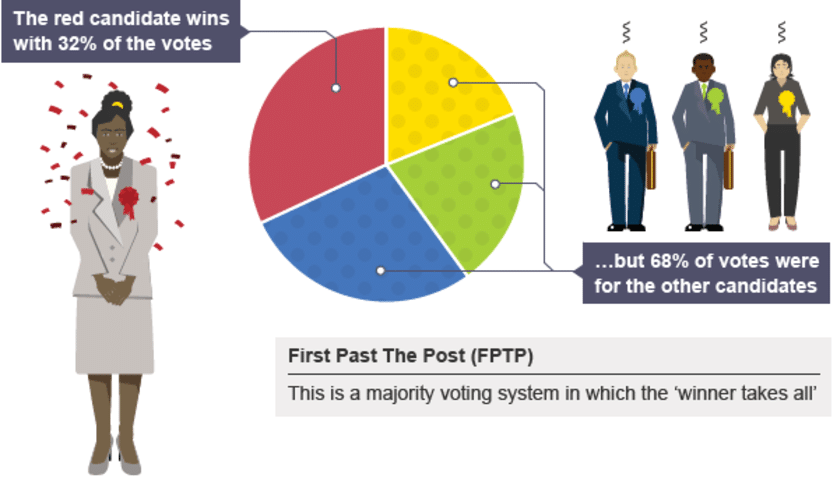
Source: Britain’s first-past-the-post (FPTP) voting system, ResearchGate
The First-past-the-post system therefore ensures a party the possible absolute majority in the House of Commons even without winning the percentage of votes. For Lord Sumption, this solidified and stabilised the political system, rendering a “high quality of British governments” over the years, no matter which party won.
But recently, it seems like the main parties are being seriously challenged by outsiders.
Collapse of the political centre across democracies: populist and anti-globalisation movements
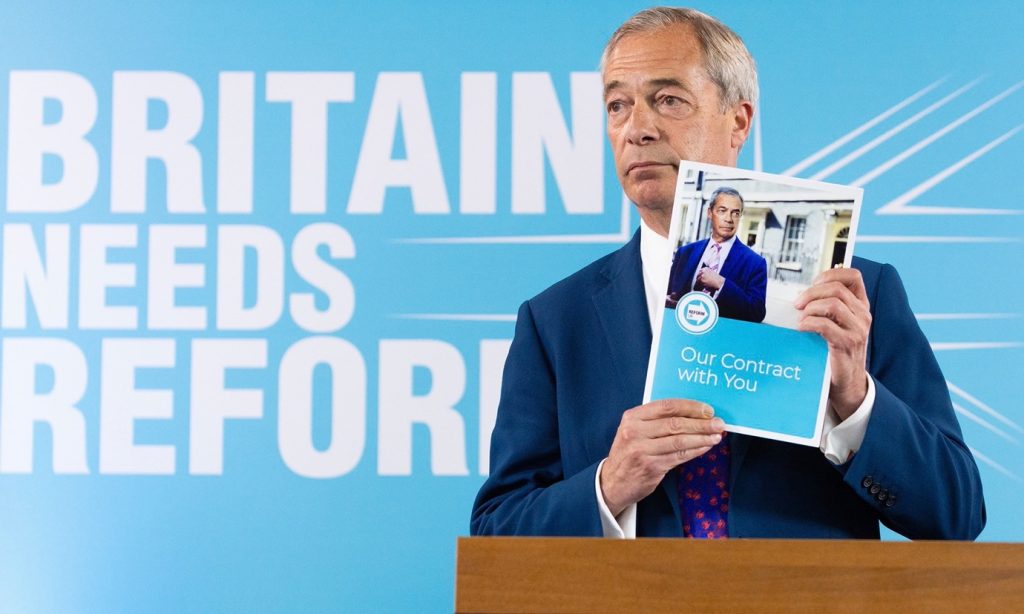
Source: The Guardian, 17 Jun 2024, A thinktank said plans to fund the spending commitments were based on ‘extremely optimistic assumptions’ about growth. Credit: Photograph EPA
Having taken root in America with the Constitution of 1788, the Liberal Democracy -which, according to Lincoln, is a Government of the people, by the people, for the people– puts equality and liberty before the law. Democracy thus takes all its legitimacy and power from the people.
Populist movements like the Trump presidency, Le Pen’s party in France, the Reform Party, the Greens, and the SNP in the UK each channel grievances on different topics oriented towards sections of the population.
This phenomenon is described by Jonathan as due to a “collapse of the centre”, itself brought about by two main occurrences: a global disappointment of people with their representatives, and economic misfortune.
On the economic side, our guest suggests a collective thought that the life work each has spent time and essence into is no longer valued at its worth due to globalization. Imports from low-wage countries, illegal low-wage workers “stealing jobs”, and even anti-legal migration stances are at the center of populist discourse. France’s Rassemblement National, Trump’s speeches, Farage’s Reform UK, all claim to have found the solution to reboost their Western economies by closing frontiers.
Sumption qualifies populism as a gathering of people who blame governments and politics for being a closed establishment of elites, and who wish to “smash things up” out of dissatisfaction and even distress. Populist parties, therefore, grab the electorate on negative aspects, often leaving out what should be and could be done to improve people’s lives.
Could there be a chance that Reform UK wins the elections? Jonathan observes an ascent in the party’s won seats, like the last local election of May 2025,when Reform won 41% of seats, and a large number of seats with a smaller proportion of the vote in Kent, “about 70% of the council seats on 37% of the vote”.
This collapse of the centre was accompanied by a collapse of the Conservative Party’s appeal, according to Sumption, for having strongly supported Brexit, which has led to economic downfall and inflation; but if Mr Farage is vehemently anti-Europe, his electorate, whether previously pro or anti-Brexiters, believes it is now best to follow strong anti-migration and, perhaps, protectionist stances.
Russia, China: Do autocracies influence populism?
Dominic, our host, believes that Russia’s disinformation campaigns have exacerbated and manipulated social divisions in our societies, due to Putin’s refusal to accept an independent Ukraine in its former imperial space. Our guest recalls a time in history, in between the great wars, when Russia was mistakenly seen by many Western countries as a response to poverty, because Stalin achieved immense and rapid industrialization that could have, but did not improve the standard of living of its people.

Source: World Politics Review, Russian President Vladimir Putin and Chinese President Xi Jinping shake hands after speaking to the media at The Grand Kremlin Palace, in Moscow, Russia, March 21, 2023. Credit: Sputnik photo by Mikhail Tereshchenko via AP.
Jonathan belittles Russia’s influence in the rise of populism in Western countries today, as its economy was not successful. However, China may appear to our populations, according to him, as a much more impressive example of economic and social growth. When putting aside the despotic and repressive aspect of governance, it is seen as a resourceful country, technologically advanced, and competitive. He warns of the danger that this appeal for China’s achievements can represent as fuel to populism. Ironically, the same supporters and admirers of such an economy will also agree to closing its doors and stop trading with China in the face of a cheaper workforce and imports, draining democracies’ economies.
Courts increasingly deciding political questions: the case of the right of abortion

Source: NPR, July 9, 2022. Participants in the Women’s March in Washington, D.C., assemble in Lafayette Square park before the march. Credit: Tyrone Turner/WAMU for NPR
In Esprit des Lois, Montesquieu theorises the separation of three powers: legislation, executive and Justice. The separation of Justice and the State has been an international pillar of democracy since the collapse of parliamentarism led to the Terror Period post National Revolution in France, making way for many human rights abuses. But courts are increasingly being asked to settle political debates. In public law cases, questions of policy are set to be settled. Jonathan explains that in Britain, the courts follow the trend of opinion of the branch in power. Taking the example of abortion, most European countries except Malta have passed Parliamentary bills to legalise it. On November 26th, 1974, Simone Veil made a speech in front of the National Assembly that led men to vote for the right to a clinically supervised abortion. In 1967, the UK passed The Abortion Act, legalising conditional abortion, which became law on 27 April 1968 and was decriminalised in June 2025.
On the other hand, the US’s judicial system is very different, and many of the States’ populations might very well be widely anti-choice. Precedent makes the law, but it can be challenged. In 1973, Roe v. Wade led the U.S. Supreme Court to decide by rule that the 14th Amendment to the Constitution was “broad enough to encompass a woman’s decision whether or not to terminate her pregnancy” and therefore protected the right to abortion in all 50 states. However, in 2021, Texas implemented the S.B. 8. Law, banning abortion at approximately six weeks of pregnancy, and the Supreme Court allowed it to take effect. Indeed, in 2022, the Supreme Court decided that Roe v. Wade was wrongly decided, ruling that the Constitution does not explicitly protect the right to an abortion, and allowing states to ban abortion. Today, 13 States have made abortion illegal, and others do not protect it.
For Jonathan, the problem is that Justice is unrepresentative; it is not legitimate to make decisions affecting public life. It is and should be clearly separated from the State to be impartial.
A counter-argument about the American Justice system is that the power of judicial review was granted to the Justices by the American People via the enactment of the Constitution. But the debate surrounding legitimacy continues.
Food for thought: recommendations and vision for the future
Sumption believes Populist parties to be inherently unstable and based on anti-establishment sentiment, led by unsuitable leaders; and therefore, they usually fall apart. However, he does foresee the possibility of the Reform UK party becoming “kingmaker”, meaning that it would have amassed enough electorate and seats that a governing party would not be able to lead without their endorsement.
Jonathan Sumption recommends that the UK adopt a more proportional form of representation, which would lead to two foreseable situations: either a kind of multi-party coalition would then arise, as small parties must join forces to reach power, could potentially be fruitful if parties align their ideologies for the good of the country, and be subject to very good leaders; or the two dominant parties would have to appeal to a larger electorate, and therefore represent a higher proportion of the spectrum of opinion. Time will tell.
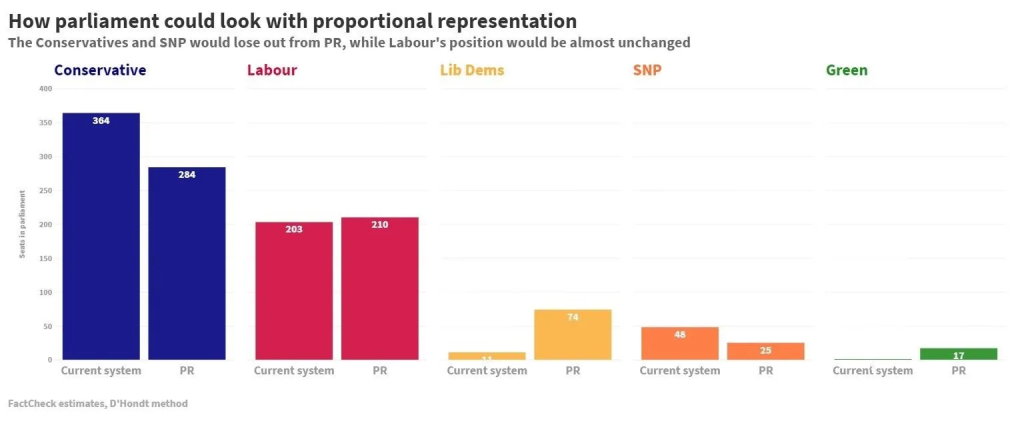
The Constitution Society, Electoral Systems. According to Channel 4 News, this is how seats would have been allocated in 2019 if the party list system had been used (a form of proportional representation).




One Comment