Life on the Frontier: What Kaliningrad Reveals About Europe’s New Border Politics
Europe’s eastern borders are no longer just the outer edges of the European Union. They are now some of the clearest places to observe how geopolitics reshapes daily life, local economies, and regional security. Few places illustrate that more sharply than Kaliningrad: a Russian exclave lodged between Poland and Lithuania, militarily important, politically symbolic, and socially exposed. For years, policymakers often treated Kaliningrad either as a strategic outpost or as an anomaly. What’s clearer now is that it’s also a warning system. When relations between Russia and Europe worsen, Kaliningrad feels it early and intensely.
The Kaliningrad-EU border region was the topic of conversation in our latest podcast episode with Dr Stanislaw Domaniewski. His research pushes us to look past abstract language about deterrence, migration, and border management. Instead, it brings the focus back to what borders actually do: they shape movement, access, cost, trust, and opportunity. They determine whether a border functions as a barrier, a bridge, or, more often, an unstable mix of both. In Kaliningrad’s case, that shift has been dramatic.
The border as a resource
Borders are not static. Their role changes with perception at all levels of magnitude—international, national, and everyday. After Poland joined the EU in 2004 and subsequently the Schengen Area in 2007, the Polish-Russian border became part of the EU’s external frontier, thereby making travel harder and increasing its blocking function. The introduction of the Small Border Traffic zone in 2012, however, changed that dynamic. The border, at least for a period, stopped being only a line of exclusion and started to become a resource. The loosening of the crossing regime reduced the social and functional distance between Poland and Kaliningrad, and opened the space for new local economic and social ties. Nearly 30 per cent of Kaliningrad’s population obtained permission to use the scheme.
Borderlands do not experience “openness” as an abstract virtue, instead experience it through practical gains. Easier movement meant cheaper shopping, medical access, leisure travel, new business models, and greater local prosperity on both sides of the border. In northern Poland, hotels, shopping centres, discount stores, and service businesses adapted to Russian demand. In Kaliningrad, residents gained something equally important: not just access to goods, but access to options. The border was no longer only something to pass through; it became part of everyday economic strategy.
Domaniewski argues that this cross-border activity was never just about necessity. Shopping and tourism were often fused together into what they describe as a specific form of “cross-border shopping tourism”. Russians crossing into Poland, Finland, and the Baltic States were drawn not just by lower prices, VAT refunds, or better quality goods, but also by leisure, cultural events, medical services, spas, restaurants, and the experience of movement itself. In that sense, cross-border life around Kaliningrad became more than trade. It became a lifestyle.
The return of great-power politics
That relative normality did not survive the deterioration in Russia’s relations with Europe. The annexation of Crimea, the tightening sanctions environment, and then the full-scale war against Ukraine transformed the operating environment around Kaliningrad once again. In their 2025 article on local border resilience, Domaniewski and his co-authors argue that the region has moved from an “open connectivity model” towards something much closer to a new Iron Curtain. Poland and Lithuania restricted cross-border activity. Mobility narrowed. Access to European goods and services became harder. And because Kaliningrad’s economy is unusually dependent on external connections, the effects were especially severe.
This is one of the most useful insights from the interview: the primacy of high politics over local wellbeing. Kaliningrad is not simply a normal border region that has suffered a downturn. It is an exclave whose residents live with dual dependency: on neighbouring EU states for access and proximity, and on a distant Russian centre for political control and economic support. That structure creates a special kind of vulnerability. When borders close or harden, Kaliningrad does not just lose convenience. It loses room to manoeuvre.
What border closure looks like in real life
The practical consequences of that shift come through most clearly in the interview itself. Domaniewski describes a Polish-side service economy that had grown around Kaliningrad demand: dental clinics, plastic surgery providers, beauty services, even birthing clinics catering to Russian residents crossing the border for higher-quality treatment. When the border environment changed, many of those business models became much harder to sustain. What disappeared was not only revenue, but a whole layer of functional integration that had quietly developed beneath grand politics.
He also gives a vivid example from Kaliningrad itself: a market trader who effectively acted as “IKEA”, carrying catalogues, taking orders, driving to Gdańsk, buying furniture, and bringing it back across the border. It was informal, improvised, and entirely rational. That story matters because it captures something larger: borders do not simply regulate state power. They reorganise how ordinary people solve problems.
This is where Domaniewski’s central argument becomes most compelling. Tight borders and securitised policies are often justified in the language of safety, order, and resilience. But in practice, many of their most immediate costs are borne by normal people. Their businesses collapse. Their options narrow. Their daily routines become more expensive and more cumbersome. His blunt formulation in the interview is probably the clearest summary of the whole discussion: “The unintended consequence of the whole thing is that normal people suffer.”
Resilience from below
The 2025 Kaliningrad resilience paper is especially useful because it avoids romanticising hardship. It does not claim that isolation is harmless or that adaptation cancels out structural damage. Instead, it shows that residents develop new coping strategies when geopolitical shocks disrupt their lives. The authors call this social borderland resilience: the ability of communities to adapt, reorganise, and create new everyday strategies despite worsening conditions. In Kaliningrad, that resilience shows up in altered travel routes, workarounds for obtaining European goods, changing mobility habits, and growing reliance on intermediaries.
That matters because resilience here is not a slogan. It is a material practice. Residents look for alternative visa routes. They use middlemen to access previously easy-to-buy products. They substitute direct travel with more complex chains of access. They adjust expectations. They seek out new internal tourism and local recreation. In other words, they do not stop trying to preserve wellbeing; they simply do it under much worse conditions. As the article notes, Kaliningraders’ resilience is closely tied to mobility and access, because movement itself is part of how they assess life satisfaction and opportunity.
But there is also a limit to this. The same paper makes clear that long-term isolation cannot be understood as a neutral adjustment. Before the war, Kaliningrad’s location near the EU attracted people precisely because of the advantages that proximity offered. After 2022, that same geography became a trap. The exclave’s European closeness remained physically real but politically unusable. That is a powerful form of frustration: being near, but cut off; seeing the alternative, but unable to reach it.
Security logic and border logic are not always the same
One of the strongest themes in the conversation is that borderland logic and national security logic do not always align. National governments look at borders in terms of sovereignty, deterrence, migration control, and military exposure. Border communities look at them through work, access, prices, opportunity, and relationships. Neither perspective is trivial. But they are not the same.
This is why Kaliningrad is such a revealing case. It shows how quickly a border can shift from being economically productive to politically restrictive. It also shows that “secure border” rhetoric can conceal highly uneven consequences. A policy that looks rational from Warsaw, Brussels, Moscow, or Vilnius may feel very different in Olsztyn, Gdańsk, Braniewo, or Kaliningrad itself. For businesses, local authorities, and communities, border hardening often means disrupted demand, stranded investment, and a sudden revaluation of entire sectors.
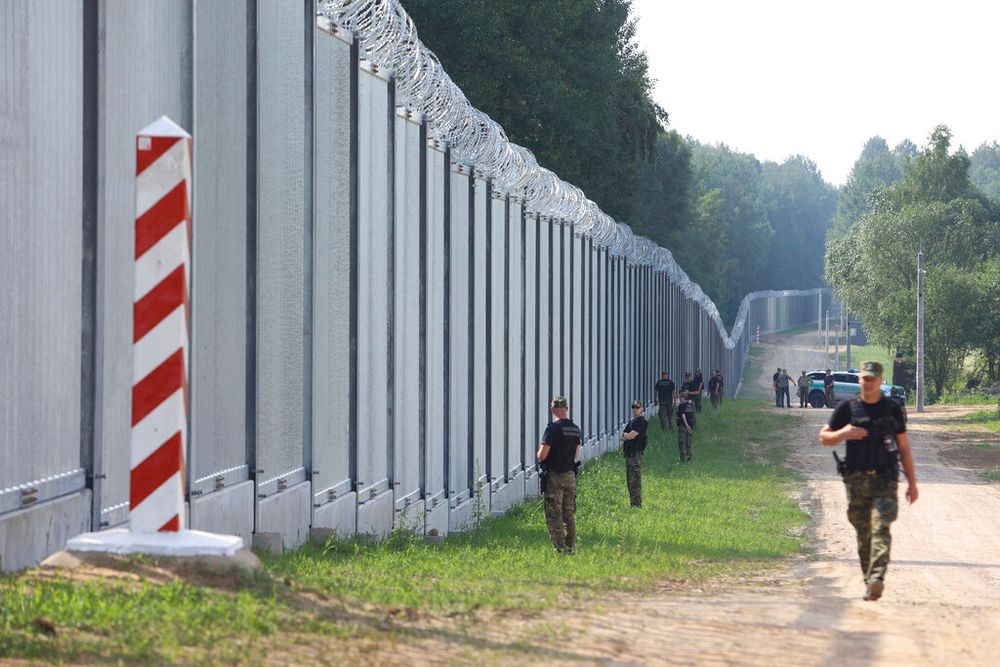
Domaniewski’s observations about Finland and Lithuania reinforce this point. Across Europe’s north-eastern edge, the trend has been toward harder borders, more visible fortification, stronger legal restrictions, and a more overtly defensive political language. That may well be understandable in the current security climate. But it also means Europe should be honest about trade-offs. Hardening a border may reduce one category of risk while deepening others: economic stagnation, local resentment, reduced trust, and chronic fragility in frontier regions.
What leaders should take from this
For policymakers, the lesson is not that borders no longer matter. Quite the opposite. It is that borders matter so much that they should never be treated as purely symbolic lines or purely military instruments. They are systems of everyday life. When policymakers close, tighten, or redesign them, they are not only changing security posture. They are changing regional development trajectories, patterns of consumption, healthcare access, labour flows, and public sentiment.
For businesses, there is a second lesson. Border regions often look peripheral in normal times, but they are frequently early indicators of larger geopolitical change. The deterioration of a border economy, the collapse of cross-border consumer routines, the rise of workaround logistics, and the sudden politicisation of mobility are all signs that the wider operating environment is changing. Companies with exposure to transport, retail, healthcare, logistics, or tourism should watch borderlands more carefully than they often do. They are rarely marginal. They are usually diagnostic.
And for Europe more broadly, Kaliningrad offers a final warning. When a border hardens, the effects do not stop at the fence line. They echo outward: into allied security debates, into regional business environments, into local political attitudes, and into the practical lives of millions who did not design the strategy but must live with its consequences. That is why borderlands matter. They are where international risk stops being abstract.
The real frontier
The old tendency was to think of Europe’s eastern borders as distant, technical, or secondary. That is no longer plausible. These are now zones where sanctions, war, migration pressure, military signalling, identity, and everyday economics meet. Kaliningrad, perhaps more than anywhere else, shows how quickly a border can move from bridge to barrier and how much damage that shift can do to ordinary life.
That is also why Domaniewski’s work is so useful. It insists on seeing the border from below as well as above. It treats local adaptation seriously without losing sight of the structural forces that make that adaptation necessary. And it reminds us that the most important question about a border is not only how well it deters, but also what kind of life it permits.
If Europe wants resilient frontiers, it will need more than fences, sanctions, and rhetoric. It will need a clearer understanding of how border regions actually function, what they contribute when they are open, and what they lose when they are shut.