Episode 355: Leading under Pressure in a More Volatile and Compounded Crisis Environment with Jon-Paul Gabriele

Business leaders are operating in a harsher, more expensive, and more politically volatile environment, where geopolitics is now showing up directly in fuel costs, inflation, supply chains, capital markets, alliance structures, and executive decision-making. I’m Dominic Bowen, host of The International Risk Podcast, where we unpack the issues shaping business, leadership, and global risk. Today,…
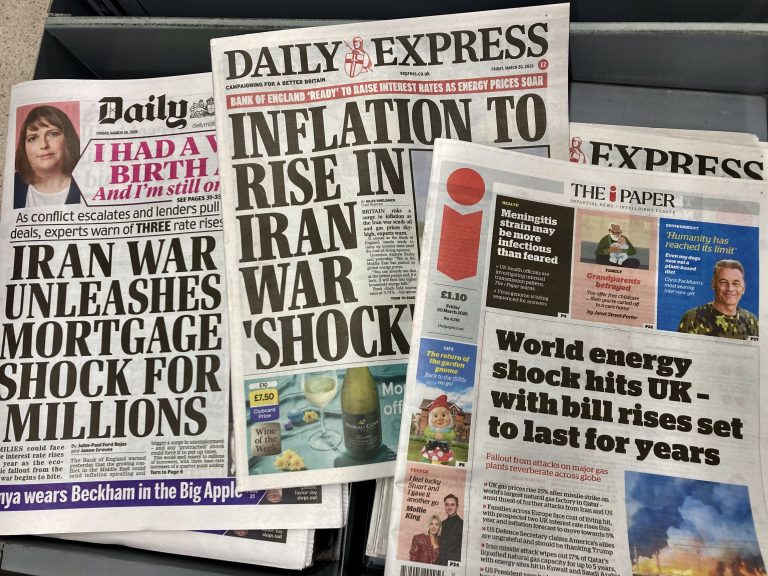
Systemic Conflict and Global Shockwaves: Rethinking the Structure of Modern Warfare

Systemic Conflict and Global Shockwaves: Rethinking the Structure of Modern Warfare

Conflict has traditionally been understood as a transition from peace to war, defined by identifiable actors, geographic boundaries, and military engagements. Increasingly, however, this framework is becoming difficult to sustain. Contemporary conflict is less a discrete event and more a continuous process unfolding across multiple domains simultaneously, from military operations and cyber activity to financial…

Episode 354: Beyond Strikes: The Ripple Effects of the US–Iran Conflict with Dr Jamie Shea

This episode with Professor Jamie Shea explores how contemporary conflict is no longer confined to the battlefield but unfolds across multiple interconnected domains, generating effects that extend far beyond the immediate theatre of operations. The conversation examines how the confrontation involving the United States, Israel, and Iran is producing systemic shockwaves across energy markets, supply…

Dr Jamie Shea

Dr Jamie Shea

Jamie Shea CMG is Professor at the College of Europe Natolin.  He is also a Senior Fellow responsible for security and defence programmes at Friends of Europe and a Senior Advisor with the European Policy Centre.  Both of these think tanks are based in Brussels.  More recently, Jamie Shea has assumed the position of Senior…

Dr Colin P. Clarke

Dr Colin P. Clarke

Dr Colin P. Clarke is one of the leading analysts of contemporary terrorism, with particular expertise in how violent organisations adapt under pressure, finance themselves, build international reach, and intersect with organised crime, proxy warfare, and geopolitics. Dr Clarke currently serves as Executive Director of The Soufan Center, having previously held roles as Director of…

Episode 353: Terrorism Rewired: AI, Crime-Terror Networks and the New Global Threat Landscape with Dr Colin P. Clarke

In this episode, we host Dr Colin P. Clarke to explore how terrorism is evolving in an era of AI, organised crime, proxy warfare, and great power competition. Drawing on decades of work on terrorism, insurgency, illicit finance, and political violence, Dr Clarke explains why today’s threat landscape is no longer defined solely by hierarchical jihadist organisations,…

Terrorism Rewired: Why Today’s Threat Landscape Is More Fragmented, Criminalised, and Global Than Ever

Terrorism Rewired: Why Today’s Threat Landscape Is More Fragmented, Criminalised, and Global Than Ever

Written by Edward Penrose – 24.04.2026 For security leaders, policymakers, and risk professionals, the most dangerous mistake today is to assume that terrorism is receding simply because some of its older forms have weakened. Terrorism is not disappearing; instead, it is mutating. What analysts previously perceived as a relatively bounded problem of distinct organisations and…

Masked hacker with credit card at computer, symbolizing cybercrime and anonymity.

Ransomware as an Industry: Inside the Economics of Digital Extortion

When ransomware shuts down a pipeline, exposes hospital data, or forces a local authority offline, the disruption is often framed as a technical failure. In reality, these incidents represent the visible edge of something far more structured: a global criminal economy that increasingly mirrors the organisation of legitimate industry. Ransomware has evolved from opportunistic hacking…

Anja Shortland

Anja Shortland

Anja Shortland is Professor of Political Economy at King’s College London, where she studies private governance in some of the world’s most complex and hostile markets, including kidnapping, piracy, fine art theft, antiquities, and ransomware. Her work explores how people trade, negotiate, and create systems of order in environments where formal state enforcement is weak…

Episode 352: Inside the Ransomware Economy: Incentives, Governance, and Risk with Anja Shortland

This episode hosts Professor Anja Shortland, returning to the podcast following her previous appearance in 2021,  to examine how ransomware has evolved into a sophisticated and highly organised form of cybercrime, operating as a global market shaped by incentives, reputation, and weak governance. The conversation explores the scale of the threat, with billions in annual losses,…