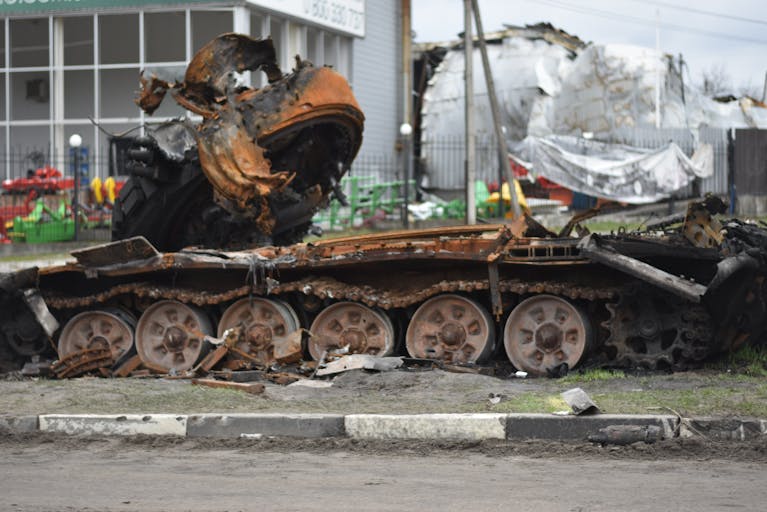
A rusted and damaged military tank lies abandoned on a city street.

Unreported, Unregulated, Unresolved: Military Emissions and the Climate Crisis

Traditional approaches to transitional justice continue to treat environmental harm as a peripheral concern. In global climate diplomacy, the environmental cost of war predominantly exists outside formal accounting. Such an emission is becoming harder to sustain as conflicts intensify and military spending rises across major powers. When delegates gathered for COP30 in November 2025, the…

Episode 359: Conflict Pollution: How Modern War Damages Climate, Water, and Land for Generations with Doug Weir

This episode hosts Doug Weir from the Conflict and Environment Observatory to examine the environmental consequences of modern warfare and the wider ecological risks created by armed conflict. The conversation explores how conflict generates complex forms of pollution, from toxic air emissions and oil fires to groundwater contamination and long-term ecological damage, often with impacts that persist…

Doug Weir

Doug Weir

Doug Weir is Director at the Conflict and Environment Observatory, where his work focuses on the environmental dimensions of armed conflict and military activity. His research examines how war and security policies contribute to environmental degradation, with a particular emphasis on pollution, ecosystem damage, and the long-term risks associated with military emissions. Doug is widely…

Episode 358: The Long Arm of Tehran: Proxies, Criminals and State-Backed Threats with Edmund Fitton-Brown

In this episode, we host Edmund Fitton-Brown to explore how Iran projects power beyond its borders through proxies, criminal networks, intelligence services, and deniable operations. Drawing on his experience as a former British Ambassador to Yemen and former senior United Nations expert on ISIS, al-Qaeda and the Taliban, Edmund explains why Iran’s external operations cannot…

Edmund Fitton-Brown

Edmund Fitton-Brown

Edmund Fitton-Brown is a former British diplomat, counterterrorism specialist, and one of the leading British voices on terrorism, Iran, proxy warfare, and Middle East security. He is currently a Senior Fellow at the Foundation for Defense of Democracies, where his work focuses on Arabian Peninsula issues, terrorism, and its enablers. He is also a Senior…

Episode 356: War on the Climate: Conflict, Carbon, and the Hidden Cost of War in Iran with Benjamin Neimark and Frederick Otu-Larbi

This episode hosts Benjamin Neimark and Frederick Otu-Larbi to examine the environmental and climate consequences of modern warfare, with a particular focus on the ongoing conflict involving Iran and its rapidly escalating global impact. The conversation explores how conflict is generating emissions at unprecedented speed and scale, with millions of tonnes of carbon dioxide released…

Benjamin Neimark

Benjamin Neimark

Benjamin Neimark is a Reader at the School of Business and Management and a former Fellow at the Institute of Social Science and Humanities (IHSS) at Queen Mary University of London. He is a human geographer and political ecologist whose research focuses on the environmental and social impacts of global supply chains, extractive industries, and…

Frederick Otu-Larbi

Frederick Otu-Larbi

Frederick Otu-Larbi is a climate and environmental scientist whose work focuses on climate change, natural resource governance, and environmental management, particularly in West Africa. With over a decade of experience, he has delivered practical, climate-focused solutions for governments, businesses, and communities. He is currently based at the University of Energy and Natural Resources in Ghana,…

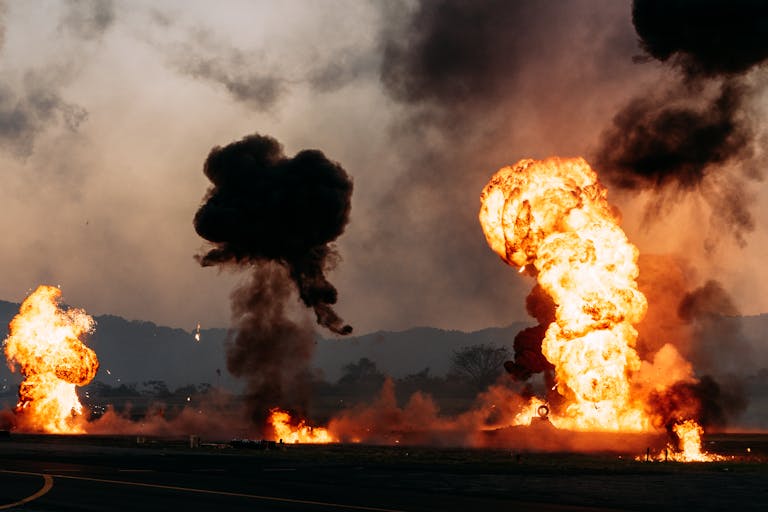
Intense fireball explosions with thick smoke in an outdoor setting.

The Iran War’s Hidden Front: Carbon, Fire and the Cost of Modern Warfare

When missiles strike refineries and cities burn, the damage is measured in casualties and territory. Far less visible is another front line: the atmosphere. In the first 14 days of the conflict involving Iran, an estimated 5 million tonnes of CO₂-equivalent emissions were released, roughly comparable to the annual footprint of a small state, and…

Jon-Paul Gabriele

Jon-Paul Gabriele

Jon-Paul Gabriele is a crisis management practitioner and founder of Crisis City, where he helps organisations prepare for the moments every business hopes will never happen but many eventually face. With more than 15 years of experience managing real incidents across government and global enterprises, he understands the difference between a crisis plan that looks…