
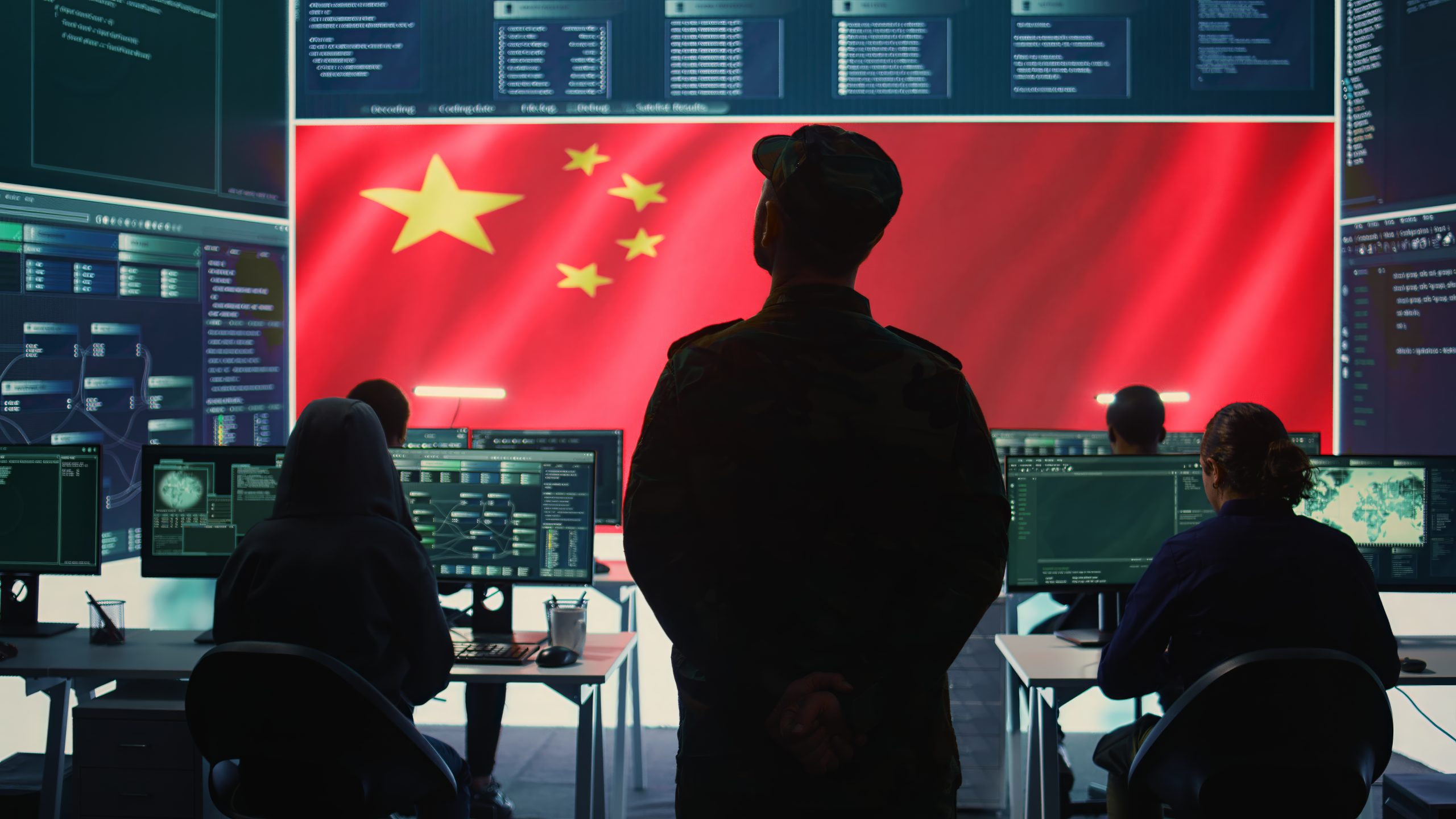
China’s Long Arm: Shadow Policing, Diaspora Fear and the New Face of Transnational Repression
Written by Edward Penrose – 29.05.26
When democratic governments talk about China’s global power, the conversation often turns to trade, technology, Taiwan, military modernisation and diplomacy. These are the familiar reference points of great-power competition. Yet a quieter and more intimate form of state power is increasingly shaping the lives of people far from Beijing or Hong Kong: surveillance, intimidation, legal pressure, financial coercion and attempts to silence critics abroad.
This is the subject of the latest episode of The International Risk Podcast, in which Dominic Bowen speaks with Sam Goodman, Senior Policy Director at the China Strategic Risks Institute and co-founder of the New Diplomacy Project. Goodman, who previously served as Policy and Advocacy Director at Hong Kong Watch, has spent years working on Hong Kong, UK-China policy, sanctions, the BN(O) community and the consequences of the Hong Kong National Security Law.
For Goodman, the most important point is that Chinese state action abroad cannot be understood only through the language of espionage or diplomatic influence. “What’s quite distinctive about China and the Chinese government compared to other governments,” he tells Dominic, “is that they consider the diaspora to be an extension of the Chinese state.” That worldview, he argues, helps explain why overseas Chinese communities, Hong Kongers, dissidents and critics can find themselves monitored, pressured or mobilised even after they have left China or Hong Kong behind.
A landmark UK case
The episode comes at a particularly significant moment for the United Kingdom. In May 2026, two men, Chi Leung “Peter” Wai and Chung Biu “Bill” Yuen, were convicted at the Old Bailey under the National Security Act 2023 for assisting a foreign intelligence service. The case centred on activity linked to Hong Kong authorities, UK-based pro-democracy campaigners and what British officials described as a “shadow policing operation” on British soil.
Yuen was a senior employee at the Hong Kong Economic and Trade Office in London. Wai, a former Border Force officer, was also convicted of misconduct in public office after misusing Home Office systems. For Goodman, the case was extraordinary not only because of the convictions themselves, but because of what it revealed about the channels through which transnational repression can operate.
He describes a case that “reads like something out of a spy thriller”, involving payments, surveillance, a fake police warrant card and the alleged use of the Hong Kong Economic and Trade Office’s bank account. But behind the dramatic details lies a wider concern: that institutions which appear commercial, administrative or community-facing can become part of a state-linked architecture of pressure.
The lesson is not that every Chinese or Hong Kong institution abroad should be treated with suspicion. Rather, it is that democratic states need a sharper understanding of how authoritarian influence can move through semi-legitimate spaces: trade offices, former police networks, private security actors, community associations, immigration systems and financial institutions.
Beyond ordinary espionage
All states gather information abroad. Embassies, consulates and trade offices often sit in the grey zone between diplomacy, influence and intelligence. Goodman is careful to distinguish between routine statecraft and transnational repression. The difference, he argues, is that democratic governments do not normally police the behaviour of their nationals overseas simply because of ethnicity, heritage or political speech.
That, he says, is what makes the Chinese and Hong Kong cases so concerning. The issue is not only surveillance, but the attempt to silence voices: Hong Kong pro-democracy activists, directly elected British politicians critical of China, journalists, students, lawyers, campaigners and others who may be far from Chinese territory but not beyond political reach.
Freedom House has described China as conducting the most sophisticated, global and comprehensive campaign of transnational repression in the world. Its research has found that China’s campaign targets multiple communities, including Uyghurs, Tibetans, Falun Gong practitioners, political dissidents, human rights activists, journalists, former insiders accused of corruption and Hong Kongers overseas. The tactics range from renditions and forced returns to digital threats, spyware, family intimidation and coercion by proxy.
This breadth matters. Transnational repression is not only about dramatic attacks or covert operations. It is also about fear: the sense that a protest photo, a public speech, a media appearance or a community meeting in London could have consequences for someone’s family in Hong Kong or mainland China.
The chilling effect
That fear is not abstract. Hong Kong Watch’s May 2026 survey of more than 1,000 Hong Kongers in the UK found that 66 per cent felt at risk of transnational repression, with 17 per cent saying they felt “majorly” at risk. Eighty-six per cent believed that participating in public events in the UK could put family members in Hong Kong at risk, and 42 per cent said they avoided public events because of that risk.
Goodman recognises this dynamic from his own work with the Hong Kong community. “There is this paranoia that they’re being watched and this real risk of infiltration,” he says. For those with family in Hong Kong or mainland China, the pressure can be even more direct. Relatives may be visited, questioned or encouraged to persuade activists overseas to stop speaking out.
This produces one of the most corrosive effects of transnational repression: self-censorship. A person does not need to be arrested in London for Beijing or Hong Kong authorities to shape their behaviour. They may simply stop attending protests, decline media interviews, avoid community meetings, withdraw from politics or refuse to be photographed. The repression has worked not because it has crossed borders physically, but because fear has.
The financial front line
One of the most important parts of Goodman’s recent work concerns economic transnational repression. This is an area often overlooked because it lacks the drama of abductions, spyware or street-level intimidation. Yet the consequences can be devastating.
Economic repression can include freezing bank accounts, blocking pension access, revoking professional qualifications, using tax authorities, threatening family livelihoods, launching lawsuits or relying on compliance systems to make dissidents financially vulnerable. In a recent China Strategic Risks Institute report, Goodman and Ray Wong identified 17 cases of alleged economic transnational repression linked to the People’s Republic of China against PRC, Hong Kong, Tibetan and Uyghur communities.
This creates a major risk for Western institutions. Banks, universities, professional bodies, employers, law firms and compliance teams may be drawn into politically motivated pressure without recognising it. A bank may receive information that appears to concern money laundering, criminality or sanctions exposure. But if that information originates from an authoritarian state targeting a dissident, the institution risks becoming an unwitting enforcer of repression.
Goodman argues that financial institutions do not need to reinvent their entire risk architecture. They already have processes for politically exposed persons, de-banking decisions and enhanced due diligence. The challenge is to apply those tools with greater political awareness, especially when information comes from states known to target critics abroad.
What democracies must learn
The UK has taken some important steps. The National Security Act 2023 has provided new legal tools. The Defending Democracy Taskforce and specialist police work show that the threat is being taken more seriously. Yet the response remains uneven. Too often, transnational repression is treated mainly as a national security issue, rather than also as a human rights and community safety problem.
That distinction matters. If the state sees the issue only through espionage, it may prioritise high-profile targets and institutional threats. But if it also sees transnational repression as a rights violation, then everyday intimidation, diaspora fear, community infiltration and family coercion become central to the response.
The policy challenge is delicate. The UK and other democratic governments must protect their sovereignty, institutions and vulnerable communities without treating entire diaspora populations as suspect. Goodman is clear that Hong Kongers in the UK should not be viewed through a crude victim-or-threat binary. Many left Hong Kong because they believed in democratic values and wanted a normal life. They should be treated as citizens, residents and neighbours, not as extensions of a foreign security problem.
The same applies to policing and intelligence. Linguistic capability, cultural understanding and trusted reporting pathways matter. Artificial intelligence may help with translation and monitoring, but it cannot replace trust. Communities are more likely to report intimidation when they believe authorities understand the threat and will not securitise them in response.
A domestic risk with global consequences
The wider lesson is that China’s global power is no longer only a question of aircraft carriers, semiconductor supply chains, trade flows or Taiwan Strait contingencies. It is also about whether open societies can protect the people inside them from foreign authoritarian pressure.
For business leaders, the risk is equally real. Companies may face exposure through staff safety, compliance decisions, data protection, event security, academic partnerships, financial services, legal demands or pressure from overseas authorities. What begins as a geopolitical issue can quickly become an organisational resilience problem.
Transnational repression works by exploiting openness: free speech, open communities, porous institutions, trusted financial systems and legal cooperation. These are the strengths of democratic societies, but they can also become vulnerabilities when authoritarian states use them to reach across borders.
The task for democratic governments is not to close those societies, but to defend them more intelligently. That means clearer definitions, better law enforcement training, stronger outreach to targeted communities, more careful scrutiny of politically motivated financial claims, and coordinated action with allies.
China’s rise will remain one of the defining geopolitical questions of this century. But as Goodman’s conversation with Dominic Bowen makes clear, the front line is not only in the South China Sea, the Taiwan Strait or the global technology race. It is also in bank accounts, community halls, universities, protest lines, family phone calls and the quiet decisions people make when they wonder whether speaking freely is worth the risk.


One Comment